 Ayati
Ayati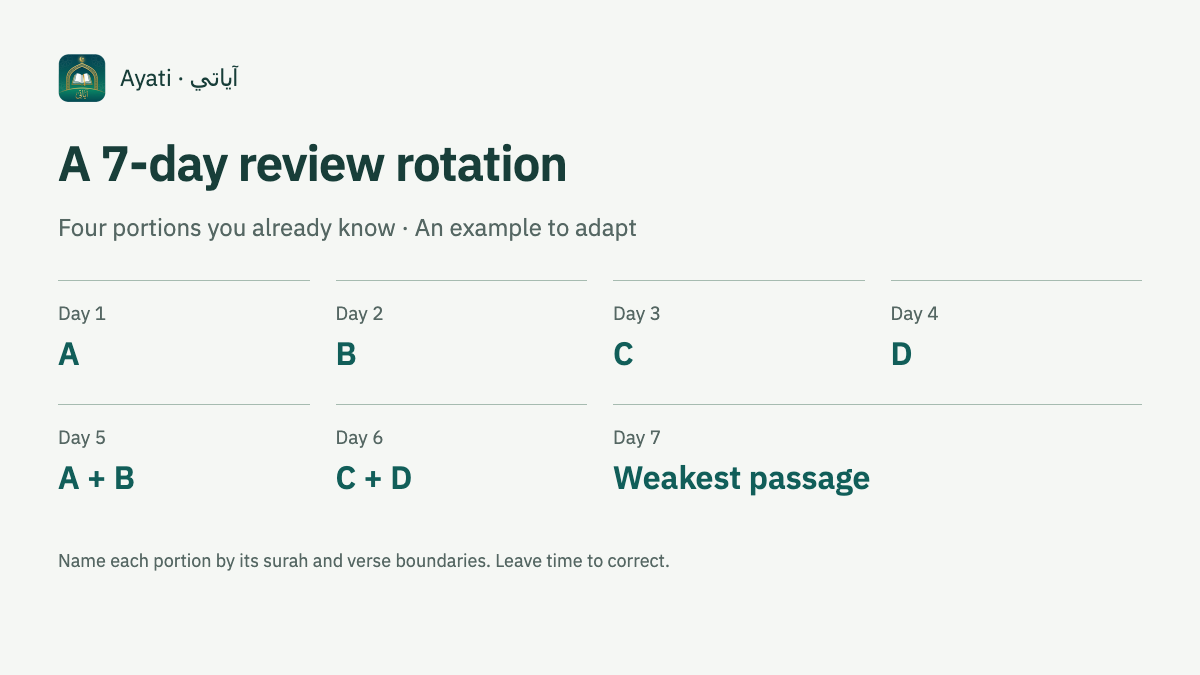
A useful Quran revision schedule tells you three things: what to recite today, which passages need another attempt, and what to return to next. Start with a manageable portion of what you have already memorized, give it a regular place in your day, and adjust the workload after you see how the reviews actually go.
This guide offers a seven-day starting plan for someone who wants to organize their Quran memorization review. You can follow it in a notebook or use Ayati to keep your rubuu cards and review results together. The plan is an example to adapt to your memorization, available time, and teacher’s guidance—not a promise that every passage will become secure in one week.
Your week at a glance
An adaptable example for four portions you already know. Identify the surah and verse boundaries of each portion, and reduce the workload if there is no time left for correction.
| Day | What to review | What to record |
|---|---|---|
| 1 | Portion A | Passage boundaries and difficult points |
| 2 | Portion B; a difficult point in A if time allows | What needs another attempt |
| 3 | Portion C | One transition to practise |
| 4 | Portion D | Weakest portion and time needed |
| 5 | A and B, in separate sessions if needed | Changes since your first attempt |
| 6 | C and D, in separate sessions if needed | Difficulties that came back |
| 7 | Weakest passage or an unfinished session | Priorities for next week |
1. Choose a review load you can actually complete
Before assigning pages to every day, try one review session. Recite a familiar portion from memory, check the places where you hesitate, and allow time to work on them. Notice how long the whole session takes, including correction.
A portion that takes a few minutes to read from the mushaf may need considerably more time when you recite from memory and revisit mistakes. Build your schedule around that complete process.
For a first week, choose a small group of portions you have already learned. You might use four rubuu, or smaller passages if that fits your current level. A rubuu is a quarter of a hizb; using a consistent unit makes it easier to identify exactly what you reviewed.
For each portion, write down its boundaries and one simple observation:
- Comfortable: you recited it without needing a prompt in this session.
- Hesitant: you continued, but paused or needed help at particular places.
- Needs rebuilding: you could not complete substantial parts from memory.
These are planning notes, not grades. A comfortable review today does not mean you can remove that portion from future review.
2. Give each session a clear beginning and end
Choose a time you can usually protect: before work, after a regular daily activity, or during a quiet evening window. The useful time is the one you can return to consistently, rather than an ambitious slot that rarely remains free.
If you have about 15 minutes, this is one possible structure:
- Two minutes to prepare: identify the passage and look at the difficult points from your previous review.
- Eight minutes to recite: attempt the selected passage from memory. If the passage is too long, work on a smaller section instead of rushing.
- Four minutes to correct: check what you missed, practise the difficult phrase, then reconnect it with the surrounding verses.
- One minute to record: note what you completed and what needs attention next time.
The times are illustrative. A longer passage or a difficult correction may need a longer session. The purpose of the structure is to leave room for correction, not to turn recitation into a speed target.
3. Try this seven-day Quran revision plan
For this example, label four portions you already know A, B, C, and D. Keep their exact surah and verse boundaries beside those labels. This is a small starter rotation, not a schedule covering everything you have memorized.
Day 1: Review portion A and establish a baseline
Recite A from memory before checking the mushaf. Mark the specific places where you stopped, confused a phrase, or needed a prompt. Work on those places and record your result.
Day 2: Review portion B, then revisit a difficult point in A
Give B its own review. If time allows, briefly return to a difficult transition from A. If A needs substantial work, assign it a separate session rather than hiding that work inside an already full day.
Day 3: Review portion C
Use the same process: recall, check, correct, and record. Look for a precise next action. “Practise the transition into the next verse” is more useful than simply writing “weak.”
Day 4: Review portion D
Complete a first review of D. Now compare your observations across all four portions. Which one needs the most attention? Did the sessions fit the time you had planned?
Day 5: Return to A and B
Attempt them again before reading your previous corrections. Then compare today’s difficulty with your notes. Two full portions may require two sessions; if your time is limited, prioritize the less secure one and schedule the other explicitly.
Day 6: Return to C and D
Follow the same approach. Give extra attention to passages where the same difficulty appears again. A repeated mistake is a specific task for the next session, not a reason to restart the whole plan.
Day 7: Work on the weakest passage and plan the next week
Use this day for a focused review or an unfinished session. Check the difficult transitions you recorded during the week. Then decide which portions should return sooner and which can move into your ongoing rotation.
The aim of the week is to leave you with both completed reviews and better information about your memorization. You do not need to add new portions merely because seven days have passed.
4. Correct the difficult passage, not only the error count
An error count can summarize a session, but it does not tell you what to practise. Keep a short note such as “needed a prompt at the beginning,” “confused two similar endings,” or “lost the connection between these verses.”
When you identify a problem:
- Check the wording in the mushaf.
- Recite the difficult phrase while looking, then attempt it without looking.
- Include the verse before or after it so that you practise the connection as well.
- Return to the passage in a later session and check it again.
For questions about pronunciation or tajwid, ask a qualified Quran teacher. A recording can help you listen back, but a sound that seems correct to you may still need another person’s guidance. Ayati’s timer, recording tools, and review log do not replace that feedback.
5. Keep older memorization in the rotation
Once the starter routine feels manageable, expand the list to include the rest of what you have memorized. Otherwise, the same few familiar portions can fill every session while older passages remain untouched.
Estimate the workload using your actual pace. For example, a list of 12 rubuu reviewed at two per day takes six days for one pass, leaving a seventh day for additional work. That is only a workload calculation: if two portions leave no time for correction, use fewer per session and a longer cycle.
Keep two visible lists: portions in your regular rotation and passages that need earlier attention. When you add new memorization, check that there is still room to revisit the older material. If your teacher already provides a schedule, use these notes to support that schedule.
6. Organize the routine in Ayati
Ayati helps you organize Quran memorization and review using rubuu cards, review sessions, and progress tracking. To try it without a large setup task:
- Open Ayati and create an account or sign in.
- Add one rubuu card for a portion you have already memorized.
- Start a review, use the session controls, and record the errors you notice. You can also record your recitation and listen back.
- Save the result, then return to your cards to see the recorded progress and next review date.
- Add more cards once the first review feels familiar.
Ayati’s review dates follow its scheduling rules and your settings. The seven-day example above is a planning illustration, not a timetable the app automatically imports. You can keep detailed passage notes in a notebook alongside the app.
What if you miss a review day?
Return at the next available session. Check what remains unfinished and choose a realistic priority, usually a passage that needs attention or has been waiting longer. Avoid automatically doubling the next day’s workload if you cannot complete it carefully.
If you repeatedly miss the same session, change one thing: make the portion smaller, move the time, or reduce the number of sessions you plan. A schedule should respond to your actual week.
Common questions about Quran revision
How many pages should I review each day?
Choose an amount you can recite and correct within your available time. Page counts alone do not account for the strength of your memorization or the difficulty of a passage. Start with a measured session and adjust from there.
Should I review before memorizing something new?
If older passages need considerable rebuilding, reserve time for that work before increasing your new memorization load. When you study with a teacher, agree on a balance that fits your current progress.
How do I know whether the schedule is helping?
Compare the same passages across several reviews. Notice whether you need fewer prompts, whether difficult transitions become easier, and whether the planned workload is sustainable. Time spent is useful context, but faster recitation alone is not the goal.
Choose one portion today, complete a careful review, and record the next thing it needs. That gives tomorrow’s session a clear starting point.